 Convexfinance
Convexfinance cvxCRV: CRV Conversion and Market Exits
Convexfinance cvxCRV holders can obtain CRV through secondary-market swaps, without reversing the original conversion of their tokens. Conversion into cvxCRV is permanent. Unstaking returns cvxCRV to the wallet and does not release the underlying CRV. A swap can then deliver CRV at the available market rate, so the amount received can differ from the original deposit.
updated
The staked balance and earned rewards represent different parts of a cvxCRV position. CRV received from a reward claim does not show that the deposited tokens were redeemed, even if both amounts appear on the same screen.
Reward staking and CRV exits
Conversion, staking and swapping each change a different part of a cvxCRV position. The Convert & Stake action combines CRV conversion with deposit into the cvxCRV reward system. Staking makes cvxCRV participate in distributions tied to Curve fees and boosted CRV earnings. A market exchange determines how much CRV an unstaked token balance can buy. Unstaking removes cvxCRV from its reward position; it does not change its token identity.
Curve liquidity provider (LP) rewards supply part of the income distributed to cvxCRV stakers. The liquidity provider’s deposit and the cvxCRV staker’s balance remain distinct positions, with different underlying assets and separate withdrawal actions. CVX vote locking serves another purpose: governance participation, rather than entry into cvxCRV staking.
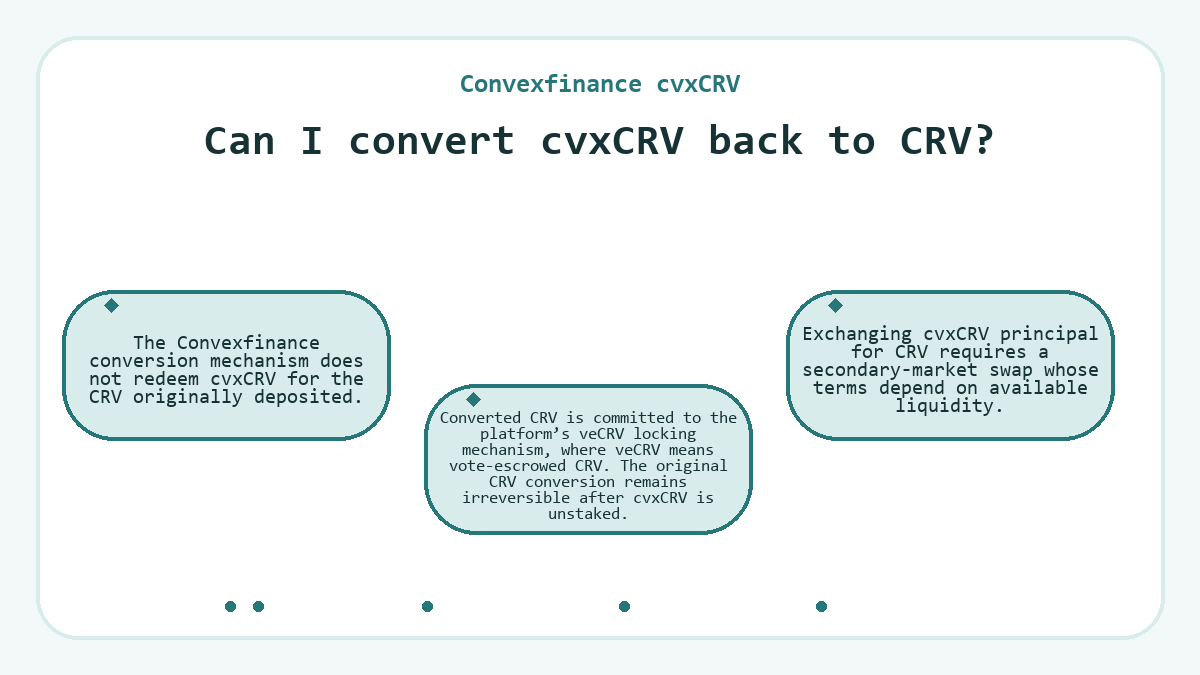
Can I convert cvxCRV back to CRV?
The Convexfinance conversion mechanism does not redeem cvxCRV for the CRV originally deposited. Converted CRV is committed to the platform’s veCRV locking mechanism, where veCRV means vote-escrowed CRV. The original CRV conversion remains irreversible after cvxCRV is unstaked. Exchanging cvxCRV principal for CRV requires a secondary-market swap whose terms depend on available liquidity.
Reward assets and allocation preferences
Fee income and token rewards
Curve’s veCRV fee distributions contribute crvUSD rewards, while a share of boosted CRV earnings from Convexfinance’s Curve LP positions supplies CRV. Eligible CRV reward claims can also mint CVX under the token’s supply-dependent rules. CVX is the platform token; cvxCRV represents the tokenized CRV deposit.
Claimed CRV is income from the staking position. Claiming it does not reduce the cvxCRV principal by an equivalent amount or undo the original conversion.
Reward preferences
Reward preferences allow a staker to allocate participation between the crvUSD stream and the CRV/CVX stream. The available choices include either stream alone or a split between them. Those selections affect which rewards accrue, while the principal remains denominated in cvxCRV.
The preference percentages describe allocation within separate reward streams, not a fixed dollar split of total payouts. Other stakers’ choices also affect the share distributed from each stream. Changes in token prices or available reward amounts can therefore change the value of the income associated with a preference, without changing the original cvxCRV balance.
Minting parity and the purchase price
Nominal issuance uses a one-to-one relationship between CRV and cvxCRV, while secondary-market purchases follow the quoted exchange price. The CRV depositor contract can adjust the minted amount through its locking incentives. Deferred locking can reduce the cvxCRV minted for that deposit by a configured caller incentive. An immediate-lock deposit can include accumulated locking incentives in its cvxCRV output.
A market discount can supply more cvxCRV per CRV than the nominal issuance ratio, before relevant costs. A premium reverses that comparison. The net conversion amount and the market purchase quote therefore need to be compared on the same basis, including their applicable costs. Neither establishes the price that will be available when the position is sold.
A secondary-market acquisition transfers existing cvxCRV ownership. It does not create a new entitlement to release platform-locked CRV. Comparing conversion with buying therefore requires the actual quoted cvxCRV amount, trading fees and network costs. Whether the chosen action includes staking also matters: obtaining unstaked cvxCRV and earning staking distributions are distinct outcomes.
Does unstaking cvxCRV return CRV?
Unstaking returns cvxCRV from the staking position, without redeeming the CRV that supports the token. The principal withdrawal and reward payment therefore need to be read by token type. A combined dollar value cannot identify which asset reached the wallet. Changes in that displayed value can also reflect token prices, without any corresponding change in token quantity.
An unstaking result with a discounted CRV quote
In this hypothetical example, a position contains 246 staked cvxCRV and the wallet holds no unstaked cvxCRV. A separate market quote offers 239 CRV for that full balance, including trading fees but excluding gas. The holder wants CRV available again and prioritizes knowing which part of the position can be reversed.
Unstaking the full position returns 246 cvxCRV to the wallet. A wallet increase of 246 cvxCRV, with no stake remaining, matches the expected withdrawal. Assuming no reward claim accompanies it, the CRV token balance stays unchanged.
The proposed sale is 7 CRV below the nominal 246 CRV parity benchmark. That difference belongs to the exchange quote, not an unstaking deduction. The 239 CRV remains a quoted amount until an exchange completes. Changing the market quote changes the CRV exit amount, while gas adds a separate cost.
Transaction costs and usable liquidity
The cost of reaching a spendable CRV balance depends on the required contract actions and the exchange available for the actual cvxCRV amount.
Network charges
Ethereum charges gas for transactions that change contract state. Approvals, conversions, staking withdrawals and market swaps can incur those charges, depending on the route and existing allowances. ETH pays network fees separately from the cvxCRV or CRV principal. The number of required transactions follows the selected interface and permissions already in place. Gas usage and prevailing gas prices determine the network charge for each transaction.
Swap size and pricing
A larger cvxCRV sale can receive a different average price because it uses more available market liquidity. A quote for a small amount therefore cannot establish the proceeds for a larger position. The relevant figure is the CRV output quoted for the actual sale amount, with its stated trading-fee treatment. Network costs remain separate. If liquidity is insufficient, a transferable cvxCRV balance still does not establish an executable CRV sale at the desired price.
Contract exposure and the CRV exit decision
A cvxCRV position depends on Convexfinance’s reward contracts and Curve’s locked-CRV and fee mechanisms. A fault in those systems can cause loss of some or all deposited funds or disrupt reward distributions. Market liquidity affects another part of the exposure: the amount of CRV obtainable when selling cvxCRV. Receiving staking income does not establish a floor for that exchange rate.
Unstaking alone cannot improve an unfavorable market quote. Keeping unconverted CRV preserves a CRV balance available for another use or sale. Staking cvxCRV provides the associated reward streams, while eventual CRV proceeds remain dependent on a market exchange.
What readers ask about Convexfinance cvxCRV
-
Do I need vote-locked CVX before staking cvxCRV?
- cvxCRV staking does not require a CVX vote lock. The cvxCRV balance participates in its own reward system, while vote-locked CVX supplies governance weight. Locking CVX does not reverse a CRV conversion or create a right to redeem cvxCRV for the underlying CRV.
-
What do My vAPR and Max vAPR mean for cvxCRV?
- My vAPR shows the cvxCRV position’s reward rate, while Max vAPR presents comparisons for the available reward streams. The latter shows rates for receiving crvUSD rewards alone or governance-token rewards alone. These displays do not establish a fixed future yield or a cvxCRV-to-CRV selling price.
-
How does CVX staking generate a cvxCRV payout?
- A standard CVX staking claim converts the pool’s earned CRV into cvxCRV before payment. Those CRV tokens enter the one-way locking mechanism that supports cvxCRV issuance. The received asset is cvxCRV, even though CRV supplied the underlying platform revenue. This is separate from staking cvxCRV to earn rewards.
-
Does the cvxCRV staking wrapper implement ERC-4626?
- The canonical cvxCRV staking wrapper does not implement the full ERC-4626 interface. It issues a transferable ERC-20 receipt over staked cvxCRV, with its own deposit, staking, withdrawal and reward accounting. It omits the ERC-4626 preview and conversion interface, so the wrapped receipt needs to be distinguished from unstaked cvxCRV.
-
Can cvxCRV reward preferences be changed from the Claim screen?
- The Claim screen provides access to cvxCRV reward preferences, alongside the option in the staking interface.
-
Is a veCRV-related airdrop automatically included in cvxCRV staking income?
- A veCRV-related airdrop through cvxCRV depends on the distribution arranged for that event and cooperation from the other platform. It is a separate, event-specific distribution. The recurring CRV, CVX and crvUSD reward streams do not establish automatic eligibility for every airdrop.
-
Why can the CRV revenue share allocated to cvxCRV stakers change?
- An authorized fee manager can adjust cvxCRV stakers’ share of boosted Curve LP CRV revenue. The contract sets ranges that bound adjustments to this allocation. A fee-share percentage describes the distribution of harvested CRV, rather than an annual return on a staker’s cvxCRV balance. Revenue, the allocation and participation in staking determine the resulting income.
-
Which token needs approval when I convert CRV into cvxCRV?
- The CRV conversion flow needs permission to spend CRV before its Convert & Stake action can execute. Approval authorizes the contract to spend tokens; the subsequent action performs conversion and staking. A sufficient existing CRV allowance for the spending contract can make another approval unnecessary.