 Convexfinance
 boosts LP rewards across Curve, Frax and f(x) Protocol
Convexfinance provides pooled reward boosts for supported liquidity provider (LP) positions on Curve, Frax and f(x) Protocol. Supported LP tokens enter staking contracts that apply shared governance-token holdings to rewards. The platform also offers cvxCRV and related token staking, alongside separate CVX staking and vote locking. These positions have different withdrawal rules: Curve LP staking is withdrawable, CRV conversion is permanent and CVX voting requires a time lock.
updated
Curve LP rewards through a shared boost
Curve LP staking provides boosted CRV rewards without requiring the LP holder to maintain a personal CRV lock. A Curve LP token represents liquidity supplied to its underlying pool. veCRV is vote-escrowed CRV, the locked form that supports Curve governance and reward boosting. Convexfinance uses its pooled veCRV holdings to support the boost applied to deposited Curve positions. The underlying pool continues to determine exposure to its assets.
Trading fees, boosted CRV and additional incentive tokens are separate reward sources. Eligible CRV reward claims can also produce CVX under its issuance rules. The boost describes a reward mechanism, while the displayed annualized rate also reflects deposits and token prices. A pooled boost therefore does not establish a fixed return for a position.
Frax and f(x) extend the staking model
Frax and f(x) each have their own app, supported positions and token-staking routes within the same platform. They apply the pooled-locking approach to different governance assets. Their underlying rewards and withdrawal conditions remain specific to the selected route.
Frax LP lock periods
While a position remains locked
Frax’s time-locked LP positions can combine the shared governance boost with an additional boost tied to lock duration. The chosen pool determines its minimum commitment, available durations and extra time boost. Its lock restricts access to the LP tokens during that period. This is separate from locking CVX for governance.
After the position’s lock expires
Frax LP positions can remain staked after their time locks expire and retain the shared governance boost. Continuing that shared boost does not require renewing the time lock; a renewed lock supports the additional time-based boost.
Governance-token staking in each app
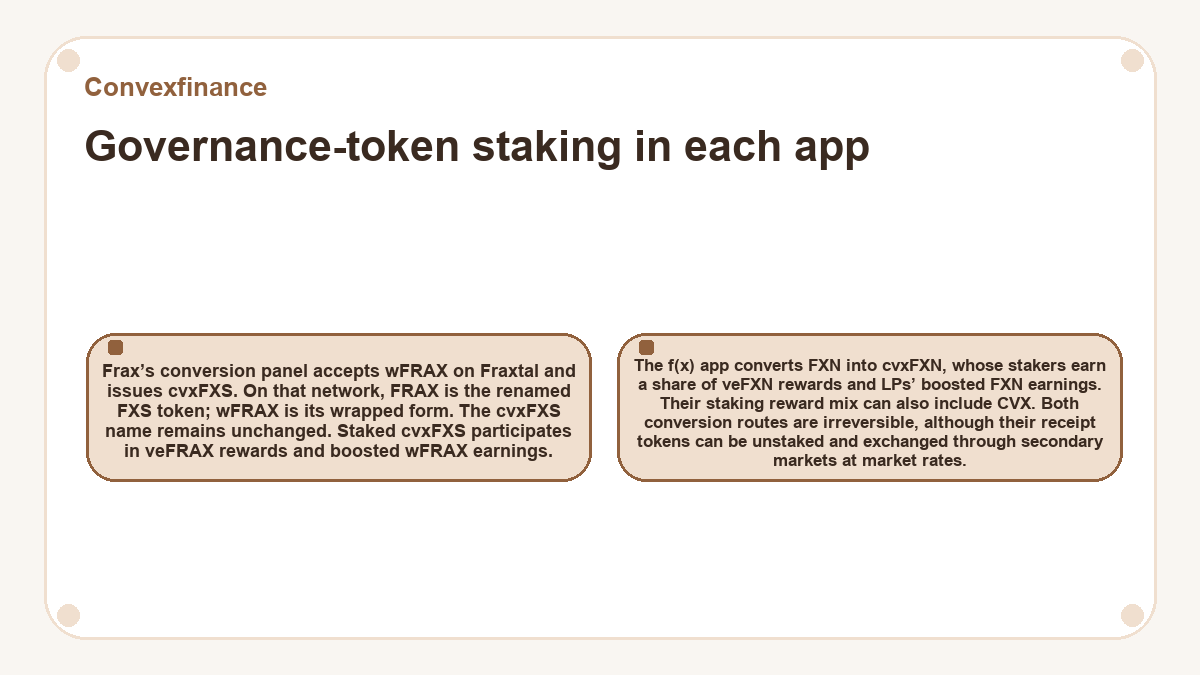
Frax’s conversion panel accepts wFRAX on Fraxtal and issues cvxFXS. On that network, FRAX is the renamed FXS token; wFRAX is its wrapped form. The cvxFXS name remains unchanged. Staked cvxFXS participates in veFRAX rewards and boosted wFRAX earnings. The f(x) app converts FXN into cvxFXN, whose stakers earn a share of veFXN rewards and LPs’ boosted FXN earnings. Their staking reward mix can also include CVX. Both conversion routes are irreversible, although their receipt tokens can be unstaked and exchanged through secondary markets at market rates.
cvxCRV separates a transferable token from locked CRV
cvxCRV represents CRV that the protocol permanently locks as veCRV, giving holders a separate token that can be staked or transferred. The tokenization uses a one-to-one ratio between locked CRV and issued cvxCRV. Unstaking releases cvxCRV; it does not reverse the underlying CRV lock. Secondary-market swaps provide a different exit, with the amount of CRV received determined by market liquidity and price. The minting ratio describes issuance, not a promised redemption rate.
cvxCRV staking supports Curve fee income in crvUSD and CRV/CVX rewards, with distribution controlled by reward preferences.
Asset control across staking choices
The platform’s non-custodial contracts hold deposited assets, with withdrawal rules specific to each staking or locking position.
| Position | Control over the deposited asset |
|---|---|
| Curve LP staking | The holder can withdraw LP tokens without a Convexfinance time lock; boosting uses pooled governance power. |
| CVX staking | The holder can withdraw staked CVX at any time; this stake does not grant CVX voting weight. |
| CVX vote locking | The holder can withdraw CVX after its lock expires; qualifying locked CVX provides governance voting weight. |
CVX is the platform’s native token. Ordinary CVX staking earns a portion of platform revenue as cvxCRV. Locked CVX earns a different fee share and supplies voting weight. Comparing these positions requires accounting for both the reward asset and the withdrawal constraint.
CVX governance runs on separate lock and voting clocks
CVX vote locking requires a minimum commitment of 16 weeks. Weekly lock epochs begin on Thursday at 00:00 UTC. A deposit made during an epoch remains locked for 16 weeks plus the time until the next epoch begins. New deposits do not contribute active voting weight during their deposit epoch. The lock must belong to a completed epoch before the relevant vote starts.
Gauge weight votes determine how emissions are directed to supported pools. Curve and f(x) gauge votes run every two weeks, separately from the weekly lock accounting. Locked CVX also participates in administrative proposals involving Convexfinance, Curve, Frax and f(x). Delegation can pass voting authority to another address without withdrawing the locked tokens. Voting for incentivized Curve or f(x) pools can also earn external rewards through Votium or VoteMarket.
Costs follow the reward stream and transaction
Curve LP staking has no platform deposit or withdrawal charge, while transaction gas and reward-level performance fees remain separate costs. The Curve performance-fee mechanism deducts a share of CRV earnings, rather than taking the same percentage from deposited LP principal. It excludes additional pool incentive tokens and veCRV administrative fees from that CRV fee basis. Fee allocations support reward recipients, treasury funding and the caller who harvests rewards.
Frax and f(x) have different fee schedules tied to their own reward streams, so the Curve fee basis is not a universal platform rule. Curve and Frax fee allocations can be adjusted within contract limits. Network gas also affects the cost of approvals, staking, claims and withdrawals. Frequent claims can make gas a larger share of the value collected from a small position. Annualized reward displays do not capture the gas paid by a particular wallet.
The underlying pool remains part of the exposure
LP staking keeps the underlying pool’s asset and contract risks in place while adding Convexfinance’s deposit and reward-contract dependencies. A boost increases a reward stream; it does not protect the value of the LP tokens. Audits address contract code within their reviewed scope, without covering every underlying asset or future vulnerability. A failure in a dependent protocol can affect a position even when the staking interface remains accessible.
Secondary-market liquidity creates an additional constraint for tokenized positions such as cvxCRV. The token can remain transferable while a trade back into CRV becomes expensive or thinly quoted. That market exit differs from withdrawing the original LP tokens from a staking contract. A personal veCRV strategy ties boost management to the holder’s CRV lock. Pooled staking applies shared governance holdings through an additional protocol.
Convexfinance questions, answered
Does connecting a wallet give Convexfinance permission to move my tokens?
Connecting a wallet does not grant a staking contract an allowance to spend your tokens. For the Curve LP route, approval grants permission for the selected token, while the deposit transaction actually stakes it. An existing sufficient allowance can remove the need for another approval. These authorizations apply to the contract and token involved, rather than every asset in the wallet.
Can Curve LP rewards be claimed without withdrawing the LP tokens?
Curve LP rewards can be claimed while the liquidity tokens remain staked in their reward position. The claim action collects the rewards that have accrued for that position. Withdrawal is a separate choice that removes the LP tokens from staking. Rewards that have not yet streamed to the position are not made immediately claimable by pressing the claim button.
Why can a projected Curve LP rate differ from the rewards accruing now?
Projected Curve LP rates reflect the pool’s current reward generation, whereas accruing rewards follow harvested reward streams. Harvested rewards stream over seven days, so deposits and withdrawals during that period change each staker’s share. Projection inputs include total deposits, the active boost, reward-token prices and additional incentives. The projection converges with the streamed rate only while those inputs remain unchanged.
What happens if unlocked CVX remains in the locker?
Expired CVX stays in the locker until it is withdrawn or relocked. The end of the lock changes withdrawal eligibility; it does not transfer the balance back to the wallet automatically. Each expired lock has its own grace period. After that period, another caller can trigger a withdrawal through the kick mechanism and receive a bounty deducted from the idle balance.
Is the CVX amount minted from a CRV claim always the same?
The CVX amount associated with a Curve CRV reward claim follows a supply-dependent issuance formula. Its minting ratio decreases as supply passes successive thresholds. New minting stops at the 100 million CVX supply cap. Receiving cvxCRV from ordinary CVX staking is a different process. That reward distribution does not itself mint additional CVX.
Are LP tokens from another venue eligible for Frax staking?
An LP token from another venue is eligible only when Frax supports the corresponding staking pool. Frax can host liquidity positions that originate outside its own exchange, and Convexfinance can provide staking for those supported positions. Token origin alone does not determine compatibility. The asset must match the selected staking pool; the Curve and Frax apps do not accept every LP token interchangeably.